Thingvellir National Park: What the Golden Circle's First Stop Actually Is
Every Golden Circle tour stops here first, gives you between 45 and 90 minutes, and leaves most people unsure what they just looked at. Thingvellir is a rift valley, a UNESCO site and the ground where a parliament met for eight centuries, and it rewards anyone who knows what to walk toward.
Thingvellir can be a quick Golden Circle stop, a private guided visit or a dedicated Silfra excursion. The right choice depends mainly on your available time and desired depth. Explore Golden Circle And Kerið
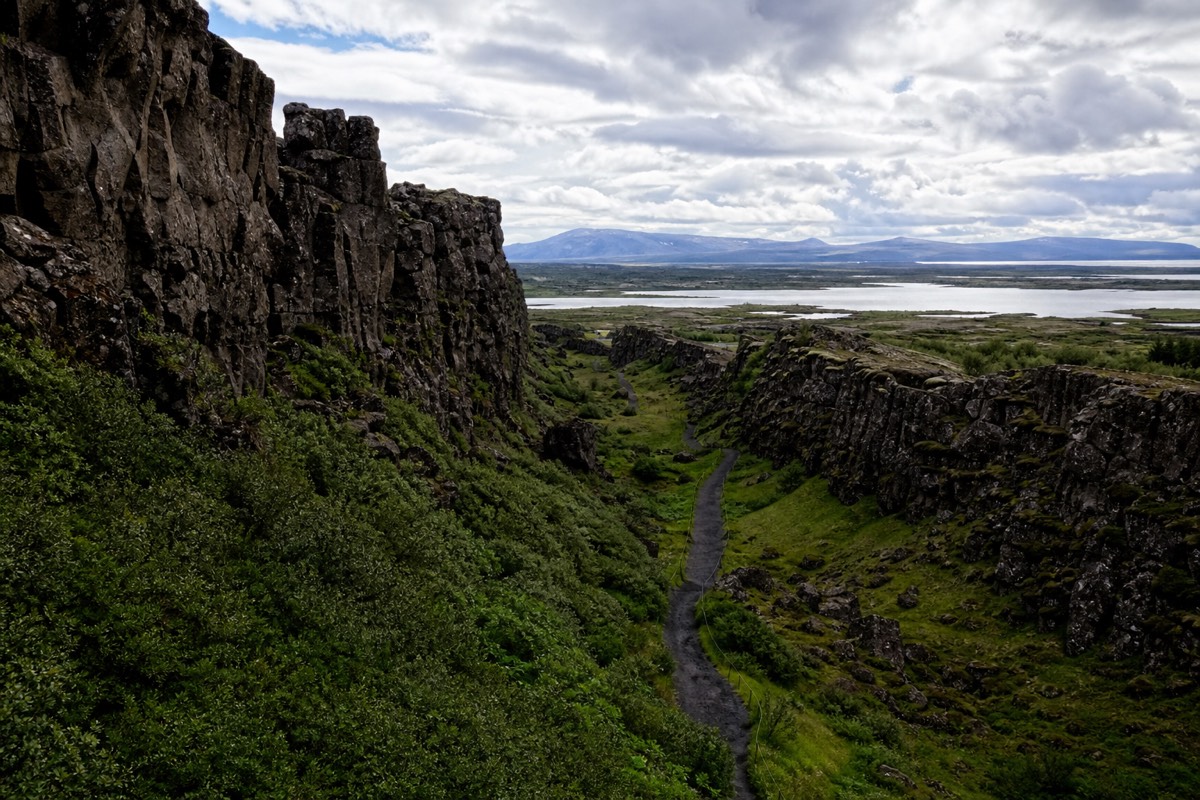
Booking Choice: Allow 45 minutes for the viewpoint and gorge, 90 minutes for Oxararfoss, or longer for the valley floor. Choose a guided Golden Circle day for transport and context, a private departure for timing control, or a separate Silfra booking for snorkeling. View Golden Circle And Kerið
What your minutes at Thingvellir buy
A 45 minute coach stop covers the viewpoint and the rift. Everything below the dotted line needs a longer visit or your own car.
What is Thingvellir, and why does it hold a UNESCO listing?
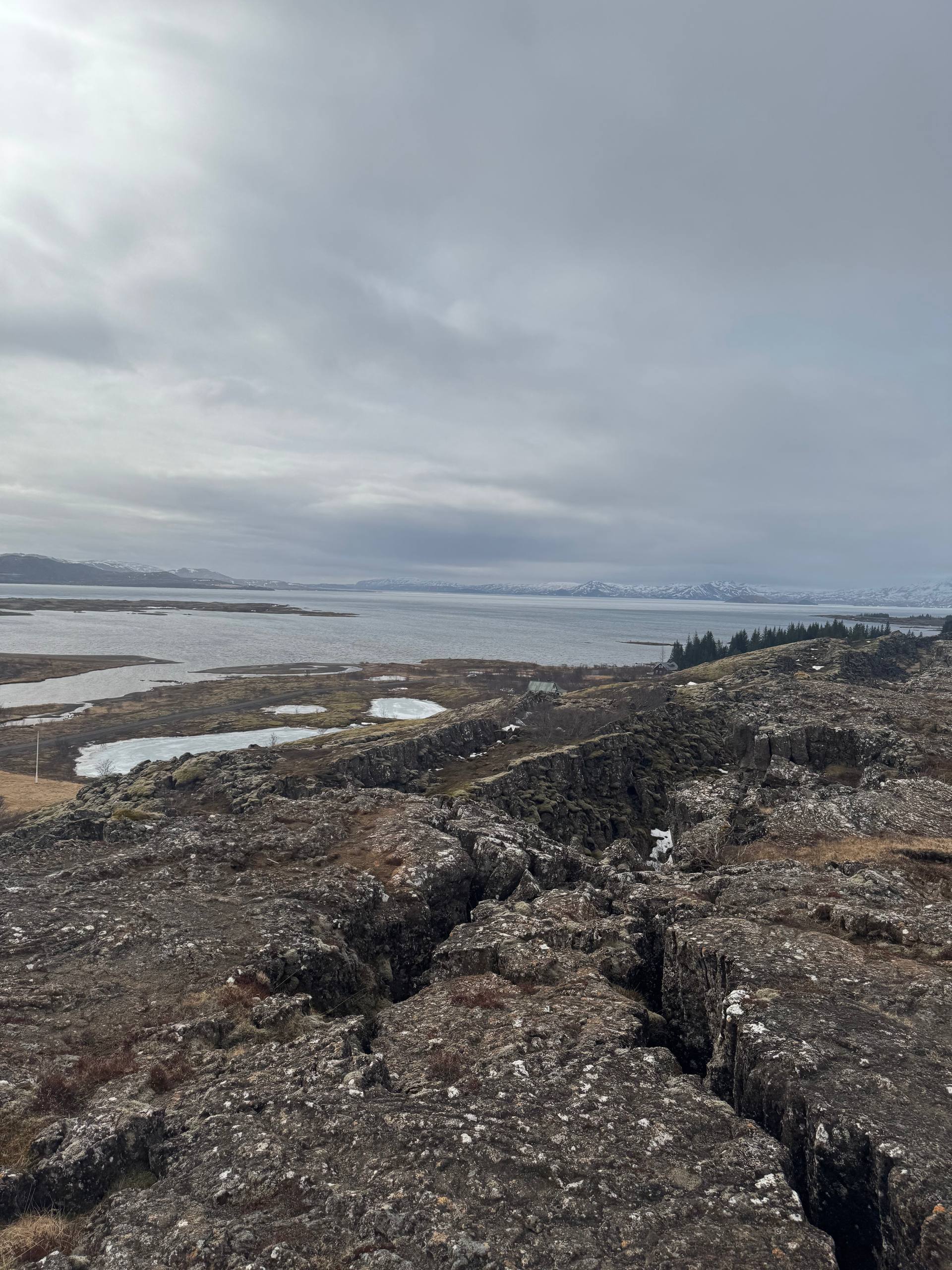
Thingvellir, written with a thorn as its first letter in Icelandic, is a rift valley 47 km from Reykjavik where the Icelandic parliament met from 930 AD until 1798. The land is pulling apart here at about two centimetres a year. UNESCO listed it in 2004 for that rare pairing: a geological boundary and eight centuries of political history in the same field.
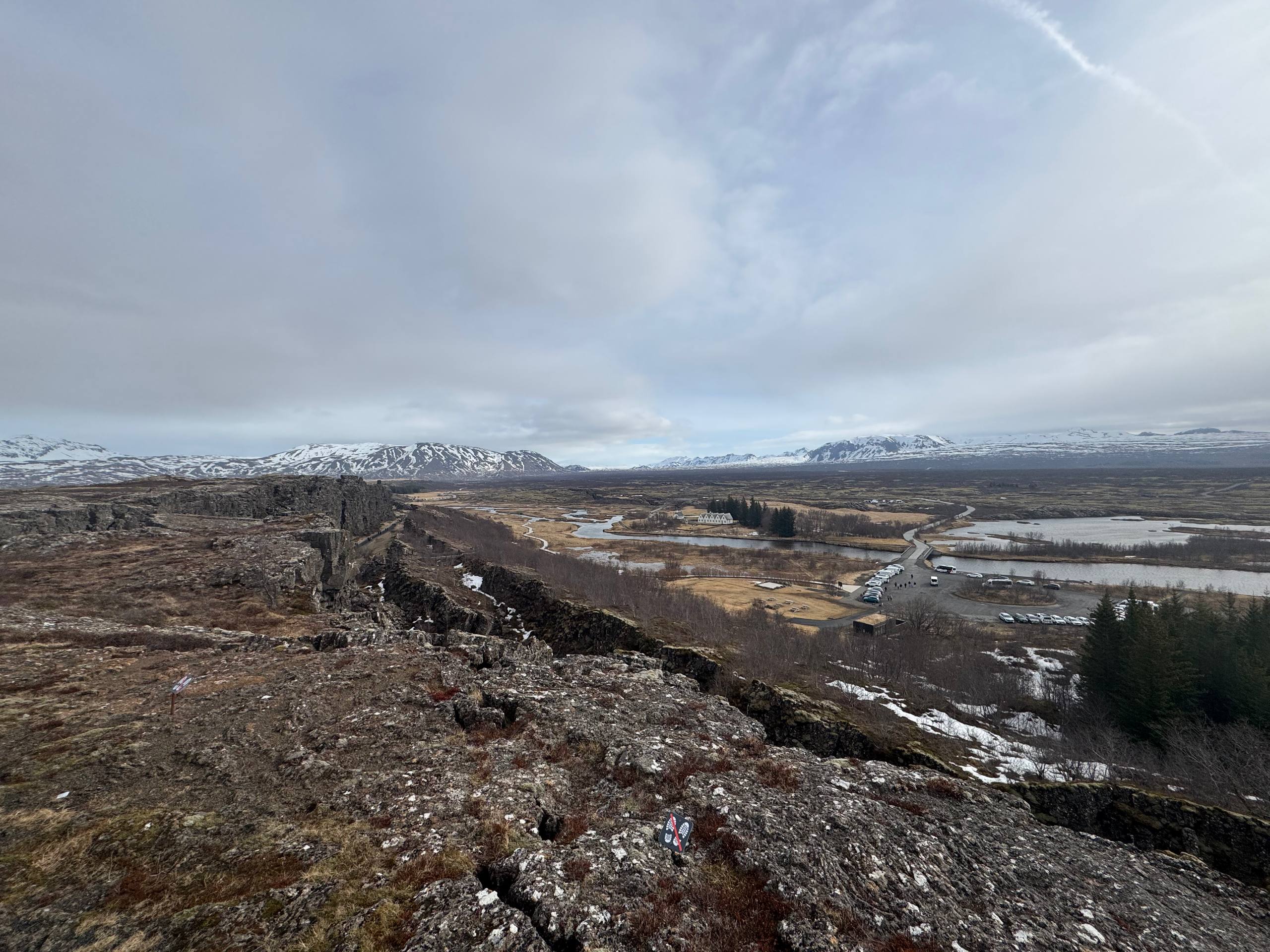
Most first-time visitors arrive expecting one of the two stories and get both at once. The geology is visible the moment you reach the viewpoint: a valley floor dropping away between rift walls, with Thingvallavatn, the largest natural lake in the country, filling the southern end. The history is less obvious, because the parliament left almost nothing behind. There is no amphitheatre, no ruin, no monument beyond a flagpole.
That absence is the point, and it is why the site is difficult to appreciate on a rushed stop. The Althing was an open-air assembly. Chieftains rode for days each summer to camp on the valley floor, laws were recited aloud from the Law Rock, disputes were settled and sentences carried out. The acoustics of the gorge did the work a building would do elsewhere. What survives is the ground itself and a listing from UNESCO World Heritage that recognises exactly that.
The park is also where the Golden Circle route begins, which shapes how nearly everyone experiences it. Coaches arrive from Reykjavik between 09:30 and 11:00, unload at the upper car park, and give the group 45 to 90 minutes before the next stop. That is enough for the headline walk and nothing else, which is fine if you know where to point yourself.
| Thingvellir at a glance | Detail |
|---|---|
| Distance from Reykjavik | 47 km, about 45 to 50 minutes on Route 36 |
| Entry | Free, no gate, open year round |
| Parking | ISK 1,000 per standard car; one ticket covers P1, P2 and P5 all day |
| UNESCO status | World Heritage listed in 2004 |
| Parliament years | 930 AD to 1798, held outdoors on the valley floor |
| Rift movement | Roughly 2 cm of separation per year |
| Main walk | Almannagja gorge, walls 30 to 40 m, about 1 km to the valley floor |
| Time on a coach tour | 45 to 90 minutes, first stop of the Golden Circle |
What does it cost to visit Thingvellir?
Nothing to enter and ISK 1,000 to park, per standard passenger car of up to five seats. One ticket covers the P1, P2 and P5 lots and stays valid for the whole day, so you can move between the upper viewpoint and the valley floor without paying twice. Guided tours absorb the fee, so bus passengers pay nothing.
The parking system trips people up because there are no barriers. You park, you buy a ticket at the machine or through the park's payment page, and enforcement happens by plate check afterwards. Plenty of visitors assume a free-looking car park is free and receive a fine in the post weeks later, which is an expensive way to save ISK 1,000.
Knowing that one ticket covers all the main lots changes how you plan a self-driven visit. Rather than doing everything from P1 at the top, you can walk the gorge downhill, drive round to P5 near the church, and see the valley floor without repeating the climb. That is the single most useful thing a driver can know here, and almost nobody arrives knowing it.
Against the rest of a Golden Circle day, this is the cheap stop. Geysir and Gullfoss charge nothing at all. The Kerid crater guide covers the one other entry fee on the loop, at ISK 600 to 700 per adult with under-12s free. If you want the full inclusion list for a guided version, what is included in a Golden Circle tour breaks down what the ticket already covers.
| What | Cost | Note |
|---|---|---|
| Park entry | Free | No gate, no ticket, open all year |
| Car park P1 (Hakid, upper) | ISK 1,000 per car | Closest to the viewpoint and the gorge top |
| Car park P2 | Covered by the same ticket | Handy for Oxararfoss from the north |
| Car park P5 | Covered by the same ticket | Valley floor, church and farmhouse |
| Ticket validity | All day | Move between lots freely once bought |
| Toilets | Small charge at the service building | Card accepted, as everywhere in Iceland |
| On a guided tour | Included | Parking is inside the tour price |
How do you get to Thingvellir from Reykjavik?
Route 36 runs 47 km from the city and takes 45 to 50 minutes without stops. It stays open and ploughed through winter because the Golden Circle depends on it. There is no useful year-round public bus, so the realistic choices are a rental car, a guided day tour, or a private transfer.
The drive itself is uncomplicated by Icelandic standards: paved the whole way, two lanes, no mountain pass. What changes in winter is not the road but the light and the wind. Ice on the descent into the park and crosswinds on the open stretch are the two things to plan for, and both are covered on the road conditions map before you leave.
For anyone weighing driving against being driven, the honest gap is smaller than it looks. Once a rental, insurance and fuel are counted, a solo traveller or a couple often lands close to the price of a small-group seat. Our page on self-drive vs guided days runs those numbers, and the winter answer differs from the summer one.
Guided is also the only version that solves the parking, the route order and the commentary at once. The Day Trips From Reykjavik tours we run leave the city early precisely so the first stop lands before the coach wave, which is worth more at Thingvellir than at any other point on the loop.
| How | Time each way | What it costs you | Best for |
|---|---|---|---|
| Rental car | 45 to 50 min | Car, fuel, ISK 1,000 parking | Anyone wanting more than 90 minutes on site |
| Guided Golden Circle tour | 45 to 50 min, first stop | One ticket, fees included | First visits, winter, no driving licence stress |
| Private driver | 45 to 50 min | Highest cost per head | Small groups with fixed timings |
| Public bus | Not a workable day trip | n/a | Nobody, in practice |
| Cycling | Several hours | Effort and weather risk | Summer only, experienced riders |
What is actually worth walking to?
In order of return on time: the Hakid viewpoint, the Almannagja gorge path, the Law Rock, Oxararfoss, and the church on the valley floor. If you only have 45 minutes, do the first three and skip the rest without guilt. If you have two hours, the waterfall is the one that repays the extra walking.
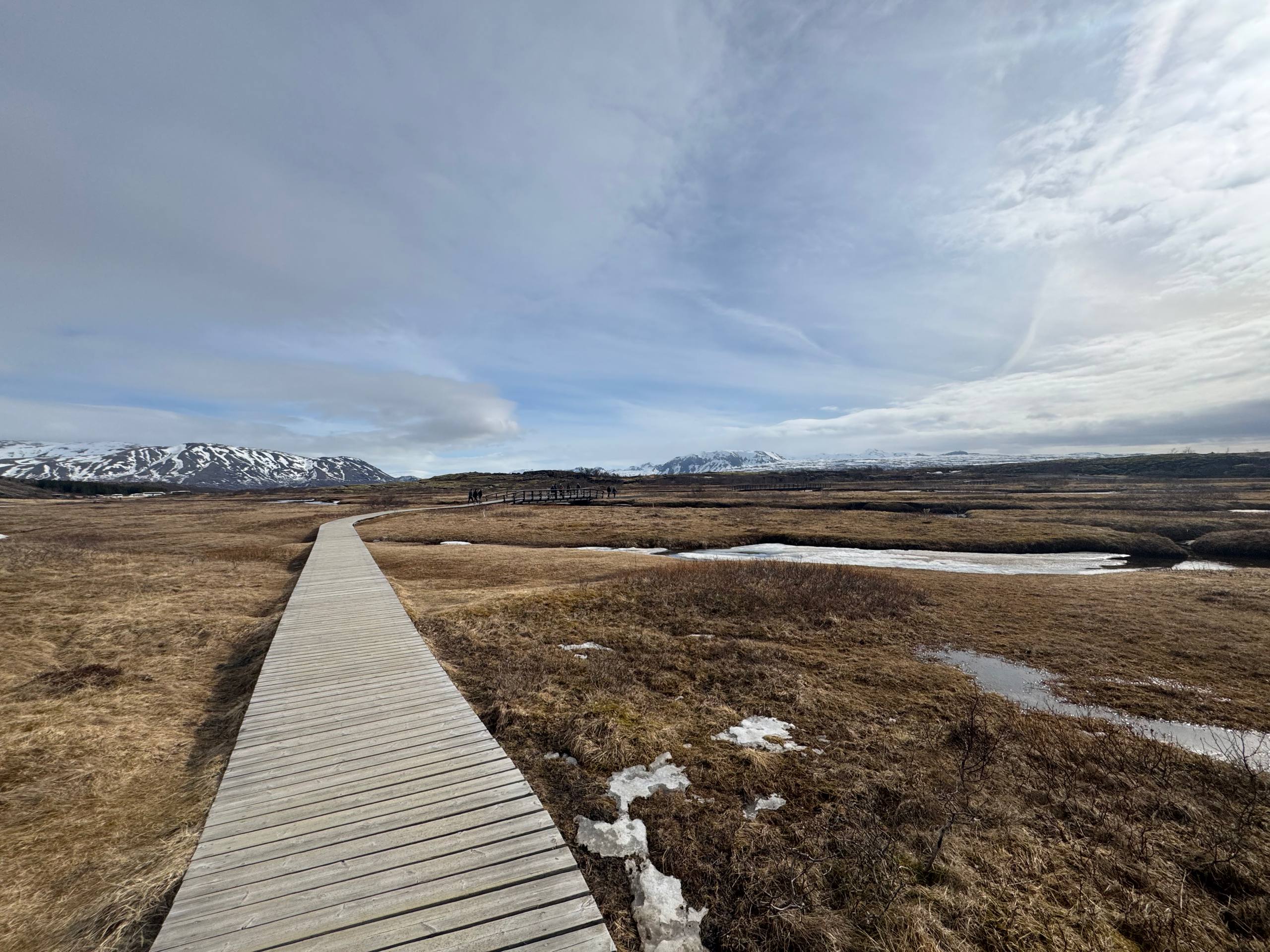
Start at Hakid, above the gorge, because the layout of the park is not obvious from ground level. From up there the rift valley drops away, the lake spreads to the south, and you can see the church and the old assembly ground far below. Guides pause here for exactly that reason, and it takes five minutes.
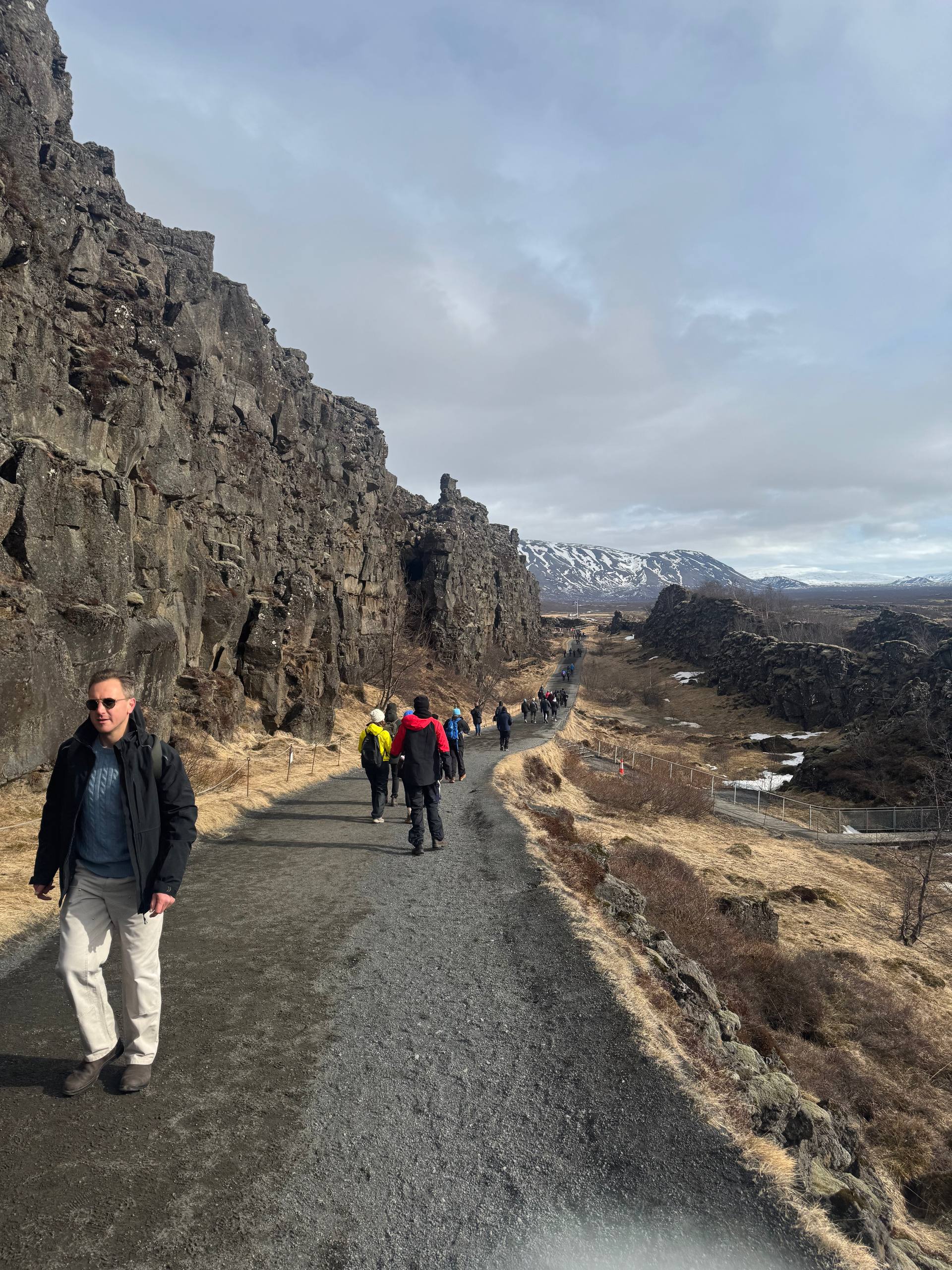
The Almannagja path is the walk everyone comes for. It descends into the rift with lava walls of 30 to 40 metres on either side and runs about a kilometre to the valley floor. The surface is graded gravel and easy, though it is downhill on the way in, which means uphill on the way back unless you have arranged to be collected at the bottom.
Logberg, the Law Rock, is the historical centre and the least visually impressive thing in the park: a marked spot with an Icelandic flag. Standing there matters only if you know that this is where the lawspeaker recited the laws from memory each year and where the country's conversion to Christianity was decided in the year 1000. This is the section where a guide earns their fee.
Oxararfoss sits 15 to 20 minutes further north on a boardwalk, drops 13 metres into a rocky pool, and freezes into ice columns in winter that look nothing like the summer version. Tours with only 45 minutes skip it. That is the loss most people do not know they took.
Down on the valley floor sit the small white church and the farmhouse buildings, and just past them the Drekkingarhylur pool, where women convicted under seventeenth-century law were drowned. The information board does not soften it, and it changes the mood of the walk in a way that is worth sitting with for a minute.
| Site | Time needed | Effort | Skip it if |
|---|---|---|---|
| Hakid viewpoint | 5 minutes | Flat, paved, from the P1 car park | Never. It orients everything else |
| Almannagja gorge path | 20 minutes down | Graded gravel, downhill in, uphill back | Mobility is limited; the view from the top still works |
| Logberg, the Law Rock | 10 minutes | Flat, on the gorge path | You are not interested in the history at all |
| Oxararfoss | 15 to 20 min each way | Boardwalk and steps | Your stop is under an hour |
| Church and farmhouse | 10 minutes | Flat, near the P5 car park | You are walking back uphill on a clock |
| Drekkingarhylur | 5 minutes | Flat, on the valley floor | Travelling with young children |
| Silfra viewpoint | 10 minutes | Flat, short drive from P1 | You are not curious about the fissure |
| Lake shore paths | 1 hour plus | Easy but long | You are on any kind of tour schedule |
How long do you actually need?
Forty-five minutes is a viewpoint and a gorge. Ninety minutes is a proper visit. Half a day is what the park deserves and what almost nobody gives it. The difference between the first and the second is one waterfall and about thirty minutes of walking.
Coach tours generally allocate 45 to 90 minutes because the Golden Circle loop runs roughly 230 km and takes six to eight hours with stops, and Thingvellir has to share that budget with Geysir, Gullfoss and often Kerid. That is a defensible split. It also means the park is the stop most often shortchanged, since the other three can be seen properly in half an hour each.
Self-drivers have the option nobody on a coach does: arrive at 08:30. Before the first buses, the gorge is close to silent, the light is low along the rift walls, and the car park is half empty. By 10:30 in July the same path carries a slow queue. Our walkthrough of what the Golden Circle day is really like covers how the timing plays out across all four stops.
| Time available | What to do | What you miss |
|---|---|---|
| 30 minutes | Hakid viewpoint, top of the gorge, back | Everything on the valley floor |
| 45 minutes | Viewpoint, walk down Almannagja to the Law Rock | Oxararfoss, church, lake shore |
| 90 minutes | All of the above plus Oxararfoss | Valley floor buildings, Silfra viewpoint |
| 2 to 3 hours | Add the church, farmhouse and Drekkingarhylur via P5 | The eastern rift and lake paths |
| Half a day | Add the lake shore and quieter eastern fissures | Nothing that matters |
| Full day | Add a Silfra snorkel slot in the morning | The rest of the Golden Circle |
What does a guided stop include here, and what gets cut?
A guided stop buys you the viewpoint, the gorge walk, the Law Rock and the commentary that makes the flat ground mean something. What gets cut is almost always Oxararfoss and the valley floor, because both need a return walk that a coach schedule cannot absorb.
The commentary is the genuine value, and it is easy to underrate before you arrive. Thingvellir has less to look at than Gullfoss and less to photograph than Strokkur. Its interest is entirely in what you know while standing there, which is why the same 45 minutes produces either a memorable stop or a shrug depending on who is talking.
The other thing a guided version handles is the walk logistics. Some operators drop the group at the top, let them walk down the gorge, and collect them at the bottom, which removes the uphill return and adds twenty usable minutes. Others park once and expect you back at the same door. It is worth checking which shape your listing describes.
A classic Golden Circle tour runs the park first, then Strokkur, Gullfoss and Kerid, and finishes with a soak at the Blue Lagoon, which is the standard order for a reason: it puts the site that needs concentration at the point of the day when everyone still has some.
When should you go?
Early, in any season. Before 09:30 the park belongs to whoever showed up, and after 16:00 in summer it empties again. Between 10:00 and 16:00 in July you are sharing the gorge with every coach on the route. Winter cuts the crowd to almost nothing but gives you only four or five hours of usable daylight.
The seasonal trade is straightforward once you see it. Summer gives long light and green moss and the ability to walk the lake shore at 21:00 under the midnight sun in Iceland, which runs from late May to late July with no true darkness in Reykjavik. Winter gives ice in the gorge, frozen spray at Oxararfoss, and paths you may have entirely to yourself, but the sun does not rise until around 11:20 in late December and sets by about 15:30.
Wind is the underrated variable. The valley funnels it, and a still day in the city can be a hard one on the exposed viewpoint. Anyone visiting between October and April should look at the forecast on the Icelandic Met Office site the night before, and treat a warning as a reason to move the day rather than to dress heavier.
| Window | Light | Crowd | What it gives you |
|---|---|---|---|
| June to August, before 09:30 | Full | Very low | The best combination available all year |
| June to August, 10:00 to 16:00 | Full | Peak | Queues on the gorge path, full car parks |
| June to August, after 18:00 | Still bright | Low | Long shadows in the rift, empty paths |
| May and September | Long enough | Moderate | The best all-round compromise |
| October and November | Shortening fast | Low | Wet, windy, cheap and quiet |
| December to February | 4 to 5 hours | Lowest | Ice formations, near-empty gorge, tight schedule |
| March and April | Lengthening | Rising | Snow underfoot with usable daylight |
Can you snorkel Silfra while you are in the park?
Yes, but only on a booked slot with a licensed operator, and not as an add-on to a coach stop. A Silfra snorkel takes two to two and a half hours on site including briefing and changing, which is more time than any Golden Circle tour gives the whole park.
Silfra is a water-filled fissure a short drive from the main car parks, fed by glacial meltwater that has filtered through lava for years and arrives with almost nothing in it. The clarity is the reason people fly here for it. The water holds 2 to 4 degrees C in every month, and you float it in a drysuit, which keeps you dry everywhere except your face and hands.
The entry rules are firm across every operator: minimum age 12, minimum height 150 cm, minimum weight 45 kg, and the ability to swim without a flotation device. Those exist because a drysuit seal cannot close properly on a smaller body. Meet-on-location slots start around ISK 19,990, and adding Reykjavik pickup takes the same snorkel to roughly ISK 27,999 to 30,990.
Free swimming anywhere else in the park's fissures is not allowed, and the rangers enforce it. The full breakdown of prices, kit and timing sits in our Silfra snorkeling guide, including how to fit a morning slot around the rest of a Golden Circle day.
What do people get wrong at Thingvellir?
Three things, repeatedly: they do not pay for parking because there is no barrier, they walk down the gorge without checking how they are getting back up, and they arrive with no idea what happened on the valley floor and conclude the site is overrated.
The third is the most common and the most fixable. Thingvellir is not a spectacle in the way Gullfoss is. It is a place where knowing five facts changes what you are looking at, and every one of those facts is on a board or in a guide's script. Five minutes of reading before you arrive is the highest-return preparation on the entire Golden Circle.
The second catches families and anyone with limited mobility. The gorge path is easy downhill and considerably less fun in reverse, particularly in wind. Either arrange a pickup at the bottom, use the P5 car park and walk up a short section instead, or accept the return climb knowingly.
And a smaller one: people photograph the flag at the Law Rock and assume it marks the rift. It does not. The rift is the wall you have been walking between for the last kilometre, and the flag marks a legal institution that met in the open air for eight centuries.
| Mistake | What it costs | The fix |
|---|---|---|
| Assuming parking is free | A fine in the post | Buy the ISK 1,000 ticket; it covers all lots all day |
| Walking down with no plan to return | An uphill kilometre on a clock | Use P5, or arrange the coach pickup at the bottom |
| Arriving between 10:00 and 16:00 in summer | Queues on a one-track path | Be there before 09:30 or after 18:00 |
| Skipping Oxararfoss | The park's best single view | Budget 40 minutes for the round trip |
| No context at all | A pleasant gorge with a flag | Read the boards, or take a guided version |
| Underdressing for the wind | A shortened visit | Windproof outer layer, whatever the city forecast said |
Who should skip Thingvellir?
Almost nobody, but visitors with one day and a strong preference for dramatic landscape over history will get more from the South Coast. Thingvellir is a thinking stop. If your idea of a good day out is waterfalls, black sand and glaciers, the route east delivers more of it per hour.
The comparison is worth making properly rather than guessing. Our page on Golden Circle vs South Coast sets the two days against each other on distance, drama and season, and the answer flips depending on how many days you have and what month it is.
Anyone with serious mobility limits should also plan carefully rather than skipping. The Hakid viewpoint is paved and accessible, and the view from the top is genuinely the best single vista in the park. It is the descent that is the problem, not the site.
How to build the rest of the day around it
Thingvellir works as the first stop of a full Golden Circle day, as a half-day on its own with a long walk, or as the front half of a morning that ends with a snorkel. What it does not work as is a quick detour, because the drive is 45 minutes each way and the walking is the whole point.
The standard build is the loop: park, Geysir, Gullfoss, then the Secret Lagoon at Fludir or a crater stop before the drive back. That fills six to eight hours and covers roughly 230 km. If you would rather sit down for the second half of the day, swapping the last stop for a lagoon is the most common upgrade and the one people report enjoying most.
The alternative build is depth over breadth: one park, half a day, and a proper walk down the gorge, out to the waterfall, along the valley floor and back by the lake. That version needs a car, and it is the one seasoned visitors return for on a second trip.
If you are stitching several days together, how far you can travel in one day sets out what is reachable from the city and what is honestly an overnight, and a Snaefellsnes day tour makes a good counterweight on the following day, since it trades the historical density of this valley for coastline, a glacier and a fishing village or two.